
Burlingame Previous Residents by Era
A useful house history starts by matching the question to the record era. In Burlingame, county land records reach back to San Mateo County’s 1856 formation, while earlier land history may sit in San Francisco County, mission, Mexican land-grant, or federal land-confirmation files. The current parcel record is a present-day anchor, not proof of who lived there. For previous residents, the strongest trail joins ownership documents to occupant sources. The table keeps those functions apart and marks the places where Burlingame shelf dates remain unconfirmed.
| Source | Years It Covers | Where Held | What It Shows |
|---|---|---|---|
| Recorder index and deed books | San Mateo County records from 1856; online cutoff not stated | ACRE web index, public terminals, deed books | Parties, transfers, legal descriptions |
| Assessor maps and parcel records | Current data; historic map dates vary | ACRE Property Maps and counter | APN, situs, maps, values, mailing clues |
| City and reverse directories | Exact Burlingame run not published online | Library, Historical Society, PLS catalog | Occupants or subscribers by year |
| Federal population census | 1850-1950 public in 2026 | NARA, FamilySearch, library databases | Households, relationships, ages, occupations |
| 1921 Sanborn maps | March 1921, 39 sheets | Library of Congress, free images | Footprint, stories, materials, land use |
| City permits | Current online; historic start not published | Burlingame permit system or CPRA request | Owners, applicants, work chronology |
| Newspapers and obituaries | Historic runs vary | California Revealed, CDNC, libraries | Family links, notices, transfers |
| San Mateo probate | Index from 2000 conversion; native Odyssey after 6/15/2016 | MIDX, Odyssey, clerk counter | Decedents, heirs, petitions, events |
For a Burlingame address, begin with the parcel and deed trail when the question is ownership. Shift to directories, census sheets, and newspapers when the question is who occupied the house. Burlingame Public Library reference staff, San Mateo County Libraries genealogy resources, the Burlingame Historical Society, the San Mateo County Historical Association, and the California State Archives can fill years that never appear in a public web index.
Note: The recorder’s official search page does not state its first online year, so older coverage must be confirmed at the counter.
Burlingame Previous Residents and the APN
Normalize the current Burlingame address before looking for previous residents. Check the street number, direction, suffix, and unit, then use the San Mateo County Assessor Maps instructions to search by street address. The result can lead to an APN, an assessor map, and available recorded subdivision maps. The county Property Maps viewer adds city, ZIP, district, parcel, and subdivision layers. Save the APN and map names before moving to older records.
Burlingame geography needs a boundary check. ZIP 94010 reaches Hillsborough and unincorporated Burlingame Hills as well as street-delivery addresses in Burlingame. A postal city is not the same thing as a municipal line. GIS can show whether the parcel sits in Burlingame or under a county custodian. The APN links the tax and map systems, but an APN is not the legal description, and a parcel split or merger can change the number.
Keep three address clues separate. A situs address is the physical place. A mailing address receives tax or other correspondence. A business or return address belongs to a person or entity in a record and may be elsewhere. None alone proves that a past owner lived at the property. Once the parcel is stable, the deed chain and household sources can be compared without treating a mailing label as a resident list.
The current parcel step is also the point where a single-house question can widen to a full street question. When the goal shifts to every address along the block or street, the Burlingame street directory uses the same address record family from a different angle.
Burlingame Previous Residents: The Deed Chain
The San Mateo County Assessor-County Clerk-Recorder & Elections office, or ACRE, keeps the recorded-document index for Burlingame property transfers. Its grantor-grantee search is free, but document images are deliberately excluded from the web index. Search by party name, date range, document type, or recording number, then use the index as a pointer to a copy or public-terminal inspection. The Recorder counter is at 555 County Center, first floor, in Redwood City. The exact first online year is not stated on the official landing page, so do not assign an invented cutoff to older previous residents.
| Field or mode | Type | Required | Notes |
|---|---|---|---|
| Grantor or Grantee Name | Text | Search-dependent | Try surname and spelling variants |
| Beginning and Ending Recording Date | Date pair | No | Narrows results; exact limits are not stated |
| Document Type | Selector | No | Deeds, liens, reconveyances, and other types |
| Document or Recording Number | Text | No | Direct retrieval when known |
| Search or Clear | Buttons | Not applicable | Runs or resets the query |
Walk backward from the current assessed owner, but remember that an assessed owner is not automatically an occupant. For previous residents, treat each deed as a link between parties and a parcel, not as proof of a household.
- Save the current APN, situs address, assessor map, and legal description clues.
- Search the current owner as a grantee during a plausible purchase period, then identify the acquisition deed.
- Read the deed image or copy for the grantor, grantee, vesting, legal description, and recording details.
- Search the seller as a grantee in an earlier transfer and repeat the chain backward.
- When the web index stops, ask for a public terminal, deed-book search, or copy request through ACRE rather than guessing at a missing year.
- Grantor
- The party who conveys an interest in land.
- Grantee
- The party who receives that interest.
- Chain of title
- The linked sequence of conveyances that traces an interest from one owner to the next.
- Legal description
- The formal lot, block, map, or other land description that identifies the parcel more reliably than an old street number.
- Criss-cross directory
- An address-first directory that sorts by street and number, then names a subscriber or occupant.
- Enumeration district
- The census area assigned to an enumerator, useful when an address search fails but a household name is known.
Burlingame Deed Images for Past Residents
The San Mateo County grantor-grantee search page shows the entry point for a Burlingame previous-resident deed trail. The screen is useful because it exposes the index fields that can be copied into a request.
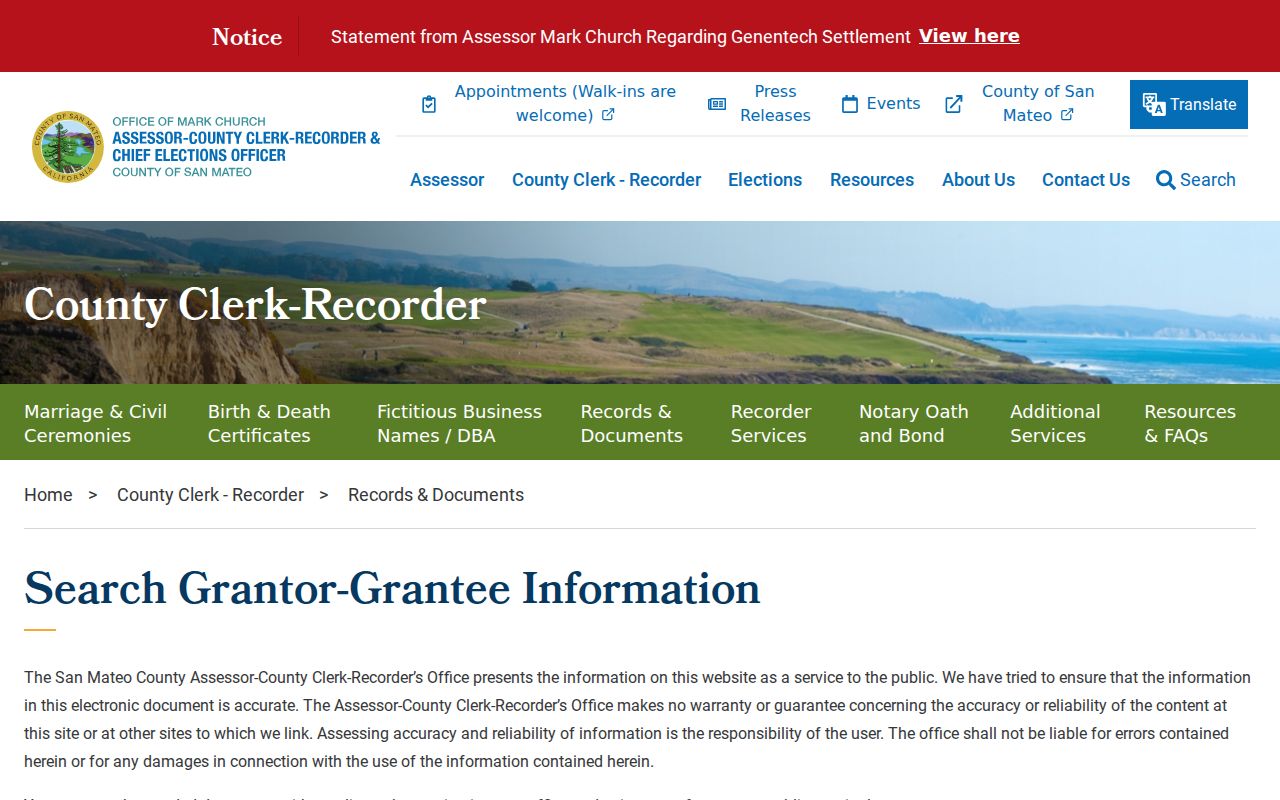
The grantor-grantee image reinforces the key limit: a free index is not the deed image. A visible result can point to indexed grantor and grantee names, party role, document type, recording date, recording number, and page count. The purchased or inspected document may add the legal description, vesting language, signatures, notary data, return address, and transfer details where not exempt.
ACRE accepts copy requests at the counter and by mail. A mail request needs the party names, document type, recording date, recording number, payment, and a self-addressed stamped envelope. The research lists a preprinted U.S.-bank check, money order, or cashier’s check payable to San Mateo County Clerk-Recorder as the payment route. Fees depend on page count, and the captured official copy page did not expose the current per-page amount. Check the linked fee material before sending money. If a deed is not found, ask staff whether the name variant, map, book, or predecessor record series should be searched next.
- Index result: indexed parties and their roles.
- Index result: document type, recording date, number, and page count.
- Deed copy: legal description, vesting, signatures, notary, and return details when available.
- Record limit: sensitive digits can be redacted, and the index is not proof of current title by itself.
Easton, Mills Estate, and Burlingame Past Residents
Older Burlingame records may use a locality that is not printed on a modern address. The 1897 Town Map laid out the early town. After the 1906 San Francisco earthquake, growth moved down the Peninsula, Burlingame incorporated in 1908, and Easton was annexed in 1910. Thirty-five more subdivisions or annexations were recorded from 1912 through 1963. In 1954, the Mills Estate territory was divided between Burlingame and Millbrae. A past resident can therefore appear under Easton, San Mateo County, or a subdivision name even when the present parcel is clearly in Burlingame.
Compare the current APN and legal description with the 1897 Town Map, Easton subdivision maps from 1905, later recorded maps, and directories held by local repositories. Search the former locality before deciding that a name is absent. The 1913-1918 Easton streetcar route, from Carmelita and California toward Hillside and Alvarado, is another clue to the early development area, but it is not a resident list.
No official source located a citywide Burlingame house-number renumbering year or a verified ZIP realignment year. An address mismatch may instead reflect an annexation, subdivision, street-name variant, or a directory transcription. Record the old and new forms, then prove the connection with a map, deed, permit, or newspaper notice.
Note: No official source documents a citywide house-number renumbering year, so each address change needs map and directory proof.
Burlingame Past Households in Directories
Owners are only part of the previous-resident story. For household history, ask the Burlingame city directory collections at the Burlingame Main Library reference desk, Burlingame Historical Society, or Peninsula Library System catalog. The exact publisher and year run for Burlingame city and reverse directories is not published in the official web sources. Search the catalog for Burlingame directory, San Mateo County directory, Polk San Mateo, telephone directory Peninsula, and reverse directory San Mateo. Then ask staff to check physical shelves, clipping files, and uncataloged local-history material.
A period entry may include a surname, given name or initial, spouse or widow notation, occupation, residence marker, street address, owner marker, business address, and cross-reference. A reverse or criss-cross section starts with the street and house number. No verified Burlingame entry image was located, so publisher-specific abbreviations should be copied only after shelf inspection. Directory absence can mean a move, death, married-name change, no telephone, a missed canvass, or a missing edition. It does not prove that previous residents never lived at the address.
Pair directory years with census years to test the household layer. The 1930, 1940, and 1950 federal population schedules can bridge changes between directory editions, while public census access reaches 1850-1950 in 2026. Use the name first, then an enumeration district or address when the scan does not read the street well.
- Set a known address and year, then search both the alphabetical entry and the reverse street section.
- Copy names, spouse notes, occupation, address, and marks exactly; keep a note about the source shelf or scan.
- Move through nearby directory years and mark the first and last appearance, along with every address change.
- Check the matching census household for age, relationship, birthplace, and occupation, then compare the household to the directory.
- Use newspapers, obituaries, maps, permits, or deeds to explain a gap rather than filling it with an assumption.
Lawful use. Burlingame previous-resident research is suited to house history, family history, estate work, and personal curiosity. Do not combine records to stalk, harass, or intimidate a living person; California Penal Code §646.9 can apply when information is used to follow, threaten, or terrorize.
Burlingame Past Residents and Sanborn Maps
The free Library of Congress Burlingame Sanborn collection contains 39 sheets from March 1921. It can show whether a structure stood at a location, along with footprint, number of stories, construction material, outbuildings, and land use. Sanborn maps do not name every occupant. Their value is spatial: pair the sheet with the legal description, directory address, and transfer dates to tell a house from a lot and a building change from a household change.
Permits add a second building layer. Burlingame permit files can identify an owner, applicant, contractor, architect, scope, valuation, parcel, dates, and inspection status. An applicant may be an agent, so a permit is evidence of work at an address, not proof that the applicant lived there. Current permit resources are online, but the historic start date is not published. Ask the city for older permit jackets by address and APN, and use the city’s public-record request route when older scans are not in the permit system.
The 1921 map is especially useful for Easton and the older Burlingame grid, while later Mills Estate and postwar subdivision questions may depend more on recorded maps, deeds, directories, and permits. If a stable APN has a demolition or alteration file, compare the permit dates to the deed chain before assigning a change to previous residents.
Burlingame Past Residents in Probate
Probate and obituary records can close a former owner or occupant trail when a household member died at or after leaving a Burlingame address. The San Mateo Superior Court Odyssey portal guidance explains the public case route for nonconfidential probate matters. Odyssey needs no registration and supports Smart Search by case number or party name, with a wildcard for a partial name. MIDX supplies broad index discovery, while Odyssey adds registers of actions and eligible documents.
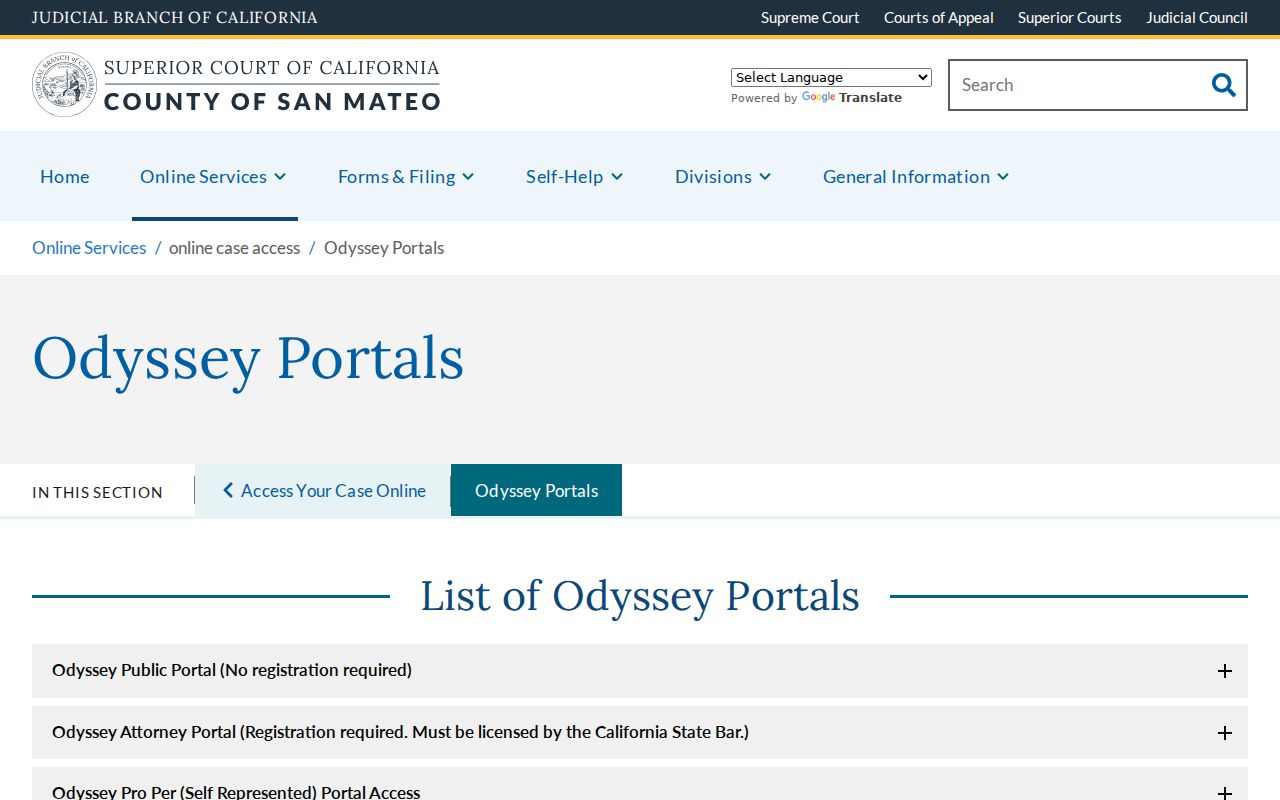
The Odyssey guidance image points to a useful difference between a name hit and a case trail. A public result may show a case number, caption, case type, filing date, status, party roles, judicial officer or location, events, hearings, comments, and permitted document links. Adoption, juvenile, and mental-health information is not online, and confidential or sealed cases are absent rather than proof that no proceeding exists. Adoption records are sealed under California law and use statutory or court routes.
| Public probate result field | House-history use |
|---|---|
| Case number and caption | Connects a decedent or estate to the court record |
| Filing date and status | Places the proceeding in time and shows its stage |
| Party names and roles | Suggests heirs, petitioners, creditors, or representatives |
| Register events and hearing entries | Shows petitions, notices, hearings, and dispositions where public |
| Document links | Provides eligible nonconfidential files or a lead for a clerk request |
For a death or marriage clue, the San Mateo County vital-record fees page is the official request reference. The 2026 county fees listed in the research are $34 for birth, $26 for death, and $19 for marriage. A search fee is retained when no record is found. The CDPH Vital Records overview, authorized-versus-informational copy rules, and state fee schedule explain the parallel California route. County and CDPH copies follow authorized-versus-informational rules, and authorized mail requests require a notarized sworn statement. There is no simple California age cutoff that makes every ordinary certificate open.
The San Mateo County vital-record fees page is the official source shown below.
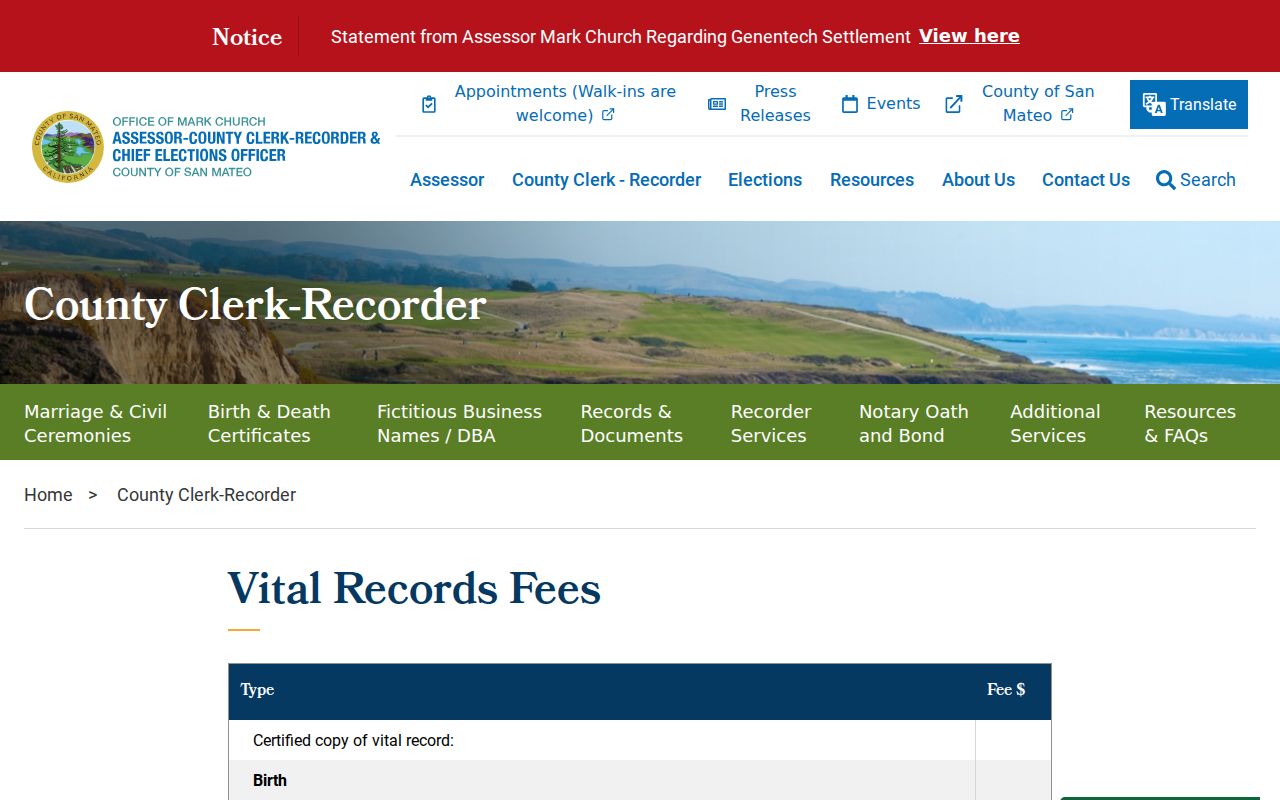
The fees image belongs beside the request path, not as proof of a family link. Use the county or CDPH application with the event name, date, place, parents or spouses, requester relationship, and authorized or informational choice. Obituaries, cemetery records, and probate can suggest a relationship, but a certificate or court file is the stronger confirmation.
Burlingame Record Requests for House History
When a Burlingame index ends, switch to a focused request rather than a broad demand for a resident list. The city’s Laserfiche public-records portal began in January 2021 and retains request and response activity. A request should name the department, date range, address or APN, record series, and desired format. Under the California Public Records Act, the agency generally makes an initial determination within ten calendar days, but production can follow later. Inspection is ordinarily free, while copies may carry direct duplication costs. The Burlingame public-records portal and the CPRA ten-day rule provide the request starting points.
Use the fallback that matches the missing layer. ACRE can explain a deed-book, public-terminal, or mail-copy route. The library and Historical Society can check shelves, card files, telephone directories, photographs, and local clippings. The San Mateo County Historical Association and California State Archives can bridge countywide or state-held material. For a probate file, ask the clerk about a known case number. For older permits, request an existing address or APN file, because a public-record law does not require the city to build a new residents directory.
Every lead needs a second record. Compare a deed party with a directory address, a census household, an obituary, a permit, or a probate role. Keep citations, variant spellings, old locality labels, and the difference between situs, mailing, business, and residence. That method protects the history of a Burlingame house from both false gaps and false matches.
Note: A missing name in one source is a lead to another custodian, not proof that a Burlingame household never existed.